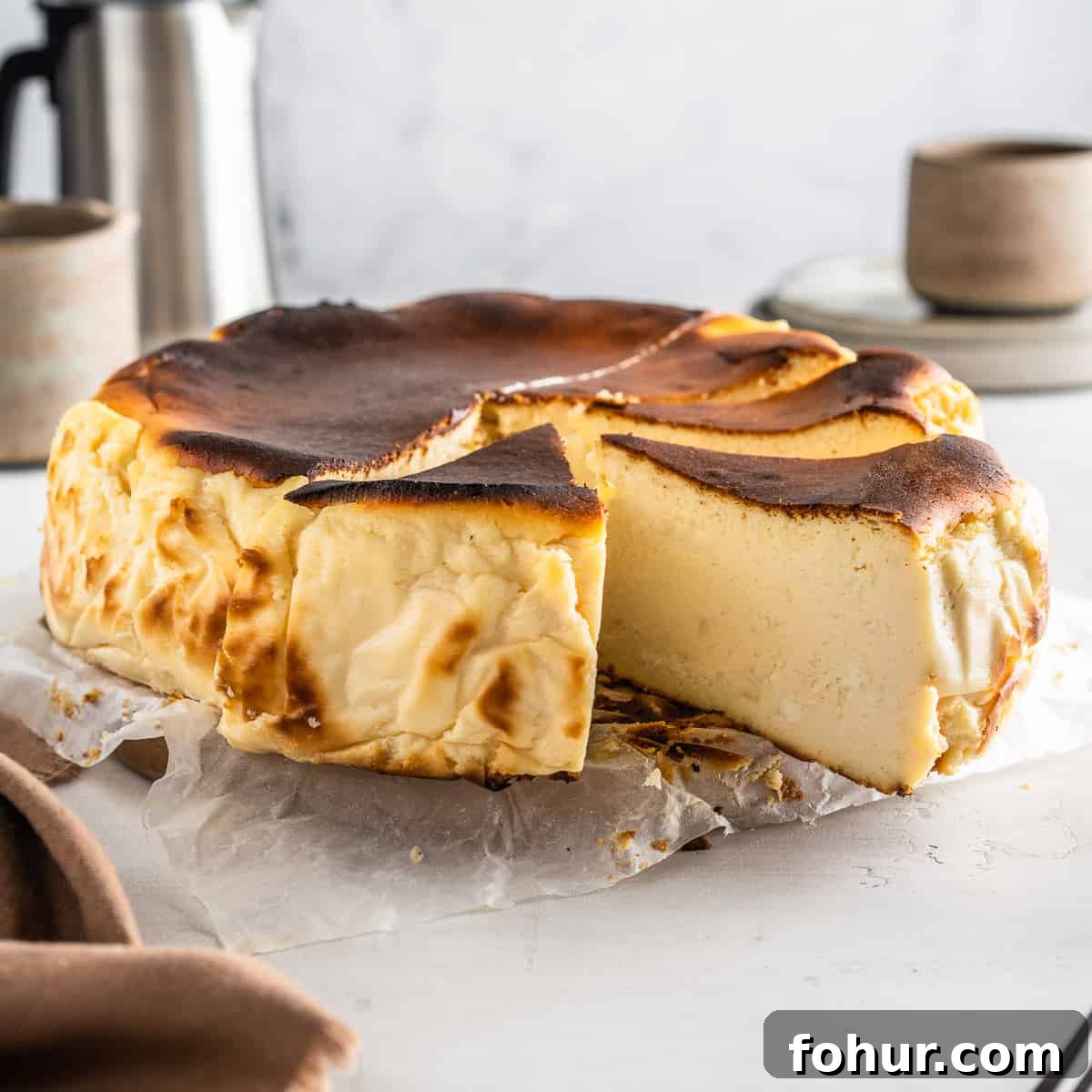
Quick Summary: San Sebastian cheesecake, also known as Burnt Basque cheesecake, is a crustless Spanish cheesecake with an ultra-creamy center and a distinctive deeply caramelized top. It bakes at high temperature without a water bath, uses just a handful of ingredients, and takes about 55 minutes including cooling.
What is San Sebastian cheesecake?
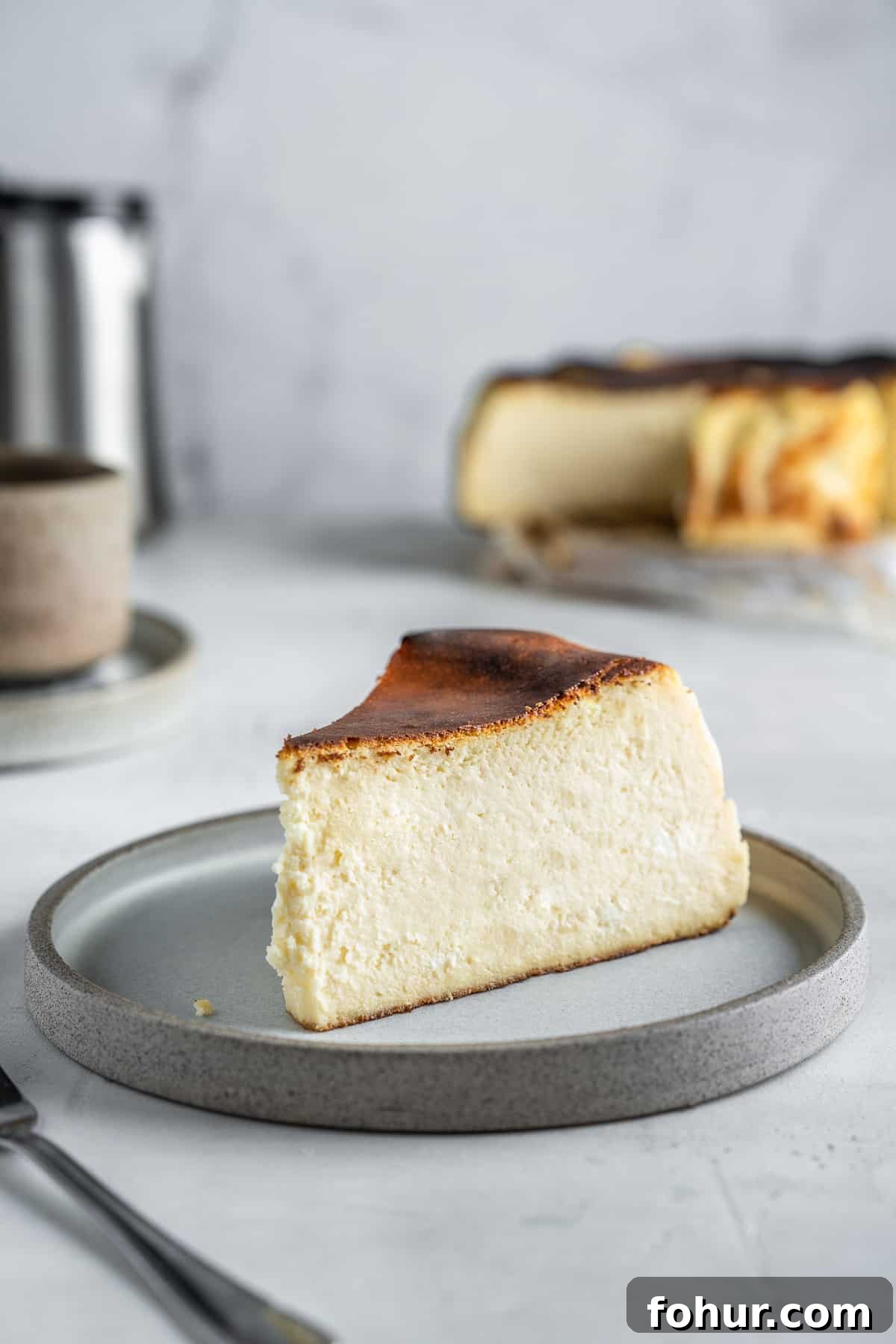
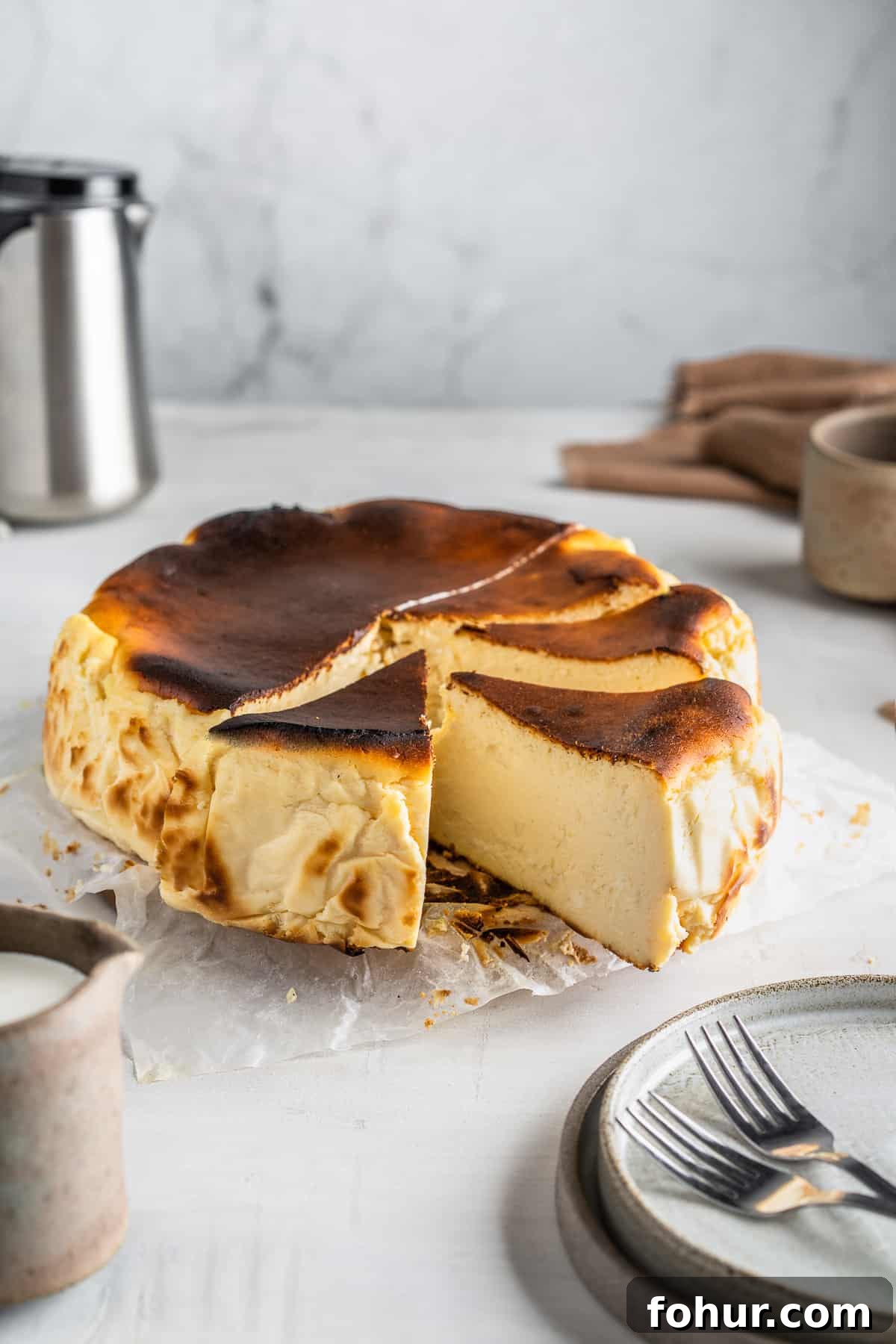
San Sebastian cheesecake — frequently called Burnt Basque cheesecake — is a crustless dessert that originated in the Basque region of northern Spain. Its hallmark is a dark, caramelized top with a deeply rich, slightly bitter-sweet flavor and a contrast of textures: a soft, custard-like interior beneath a smoky, browned surface.
The caramelized top recalls flavors like salted caramel or browned butter, while the interior remains creamy and light, less dense than a traditional New York-style cheesecake. Unlike classic cheesecakes, this version is baked at a very high temperature and not in a water bath, which produces its trademark burnt exterior and tender center.
Why you’ll love this recipe
- Minimal ingredients: The recipe uses just cream cheese, sugar, eggs, heavy cream, and a touch of flour — no crust to prepare.
- Simple baking method: No water bath or complicated techniques are required; it’s baked at high heat to achieve the classic look and flavor.
- Unique caramelized top: The deeply browned surface brings a subtle bitterness and caramel notes that balance the sweet, creamy filling.
- Creamy center: The interior stays soft, custardy, and melt-in-your-mouth, offering a different mouthfeel than denser cheesecakes.
- Make-ahead friendly: The cake is easy to assemble and often tastes even better after resting in the refrigerator overnight.
Ingredients
Refer to the recipe card below for precise measurements and timing.
This Basque burnt cheesecake requires a few simple ingredients. Be sure every ingredient is at room temperature to avoid a lumpy batter and to reduce the risk of cracks.
- Cream cheese: Use full-fat cream cheese (room temperature). Avoid whipped or low-fat varieties.
- Sugar: Granulated (white) sugar or caster sugar.
- Eggs: Large eggs at room temperature.
- Heavy cream: Full-fat cream (about 36–38% milk fat) at room temperature.
- Flour: A small amount of all-purpose flour to stabilize the batter.
Equipment
You only need a few common kitchen tools:
- Stand mixer with paddle attachment or a hand mixer
- 9-inch (23 cm) springform pan or a round pan with tall sides
- Parchment paper
- Rubber spatula
- Fine sieve or flour sifter
How to make San Sebastian cheesecake step-by-step
Step 1. Preheat your oven to 430°F (220°C) and allow it to heat for at least 30 minutes — longer is better to ensure the oven is very hot.
Pro tip: A thoroughly preheated oven helps create the characteristic deeply browned top.
Step 2. Butter a 9-inch (23 cm) pan and line it with two sheets of parchment paper. Overlap the sheets so the center lines up and press them into the base and sides. Let the parchment rise at least 2 inches (5 cm) above the rim; do not fold it down, as the batter can expand and overflow.
Pro tip: Parchment should be pleated around the edges to create the rustic, wrinkled appearance typical of Basque cheesecake.
Step 3. In the mixing bowl of a stand mixer fitted with the paddle attachment, beat room-temperature cream cheese with sugar on medium-low speed until smooth and creamy, about 2–3 minutes. Scrape down the bowl as needed.
Step 4. Add eggs one at a time, mixing after each addition. Pour in the heavy cream and mix briefly on low speed until combined. Finally, sift in the flour and mix on low until the batter is smooth and uniform.
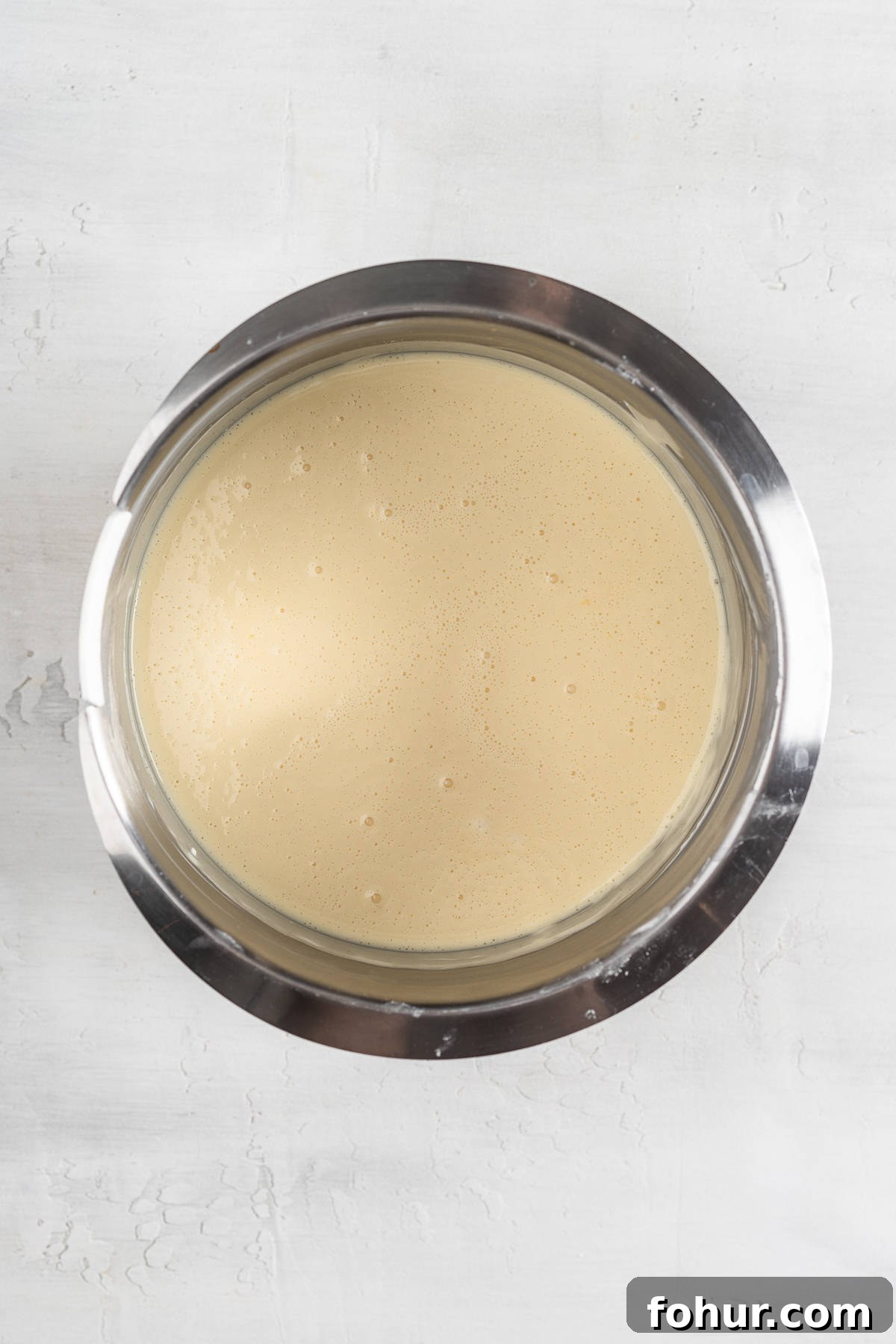
PHOTO 1
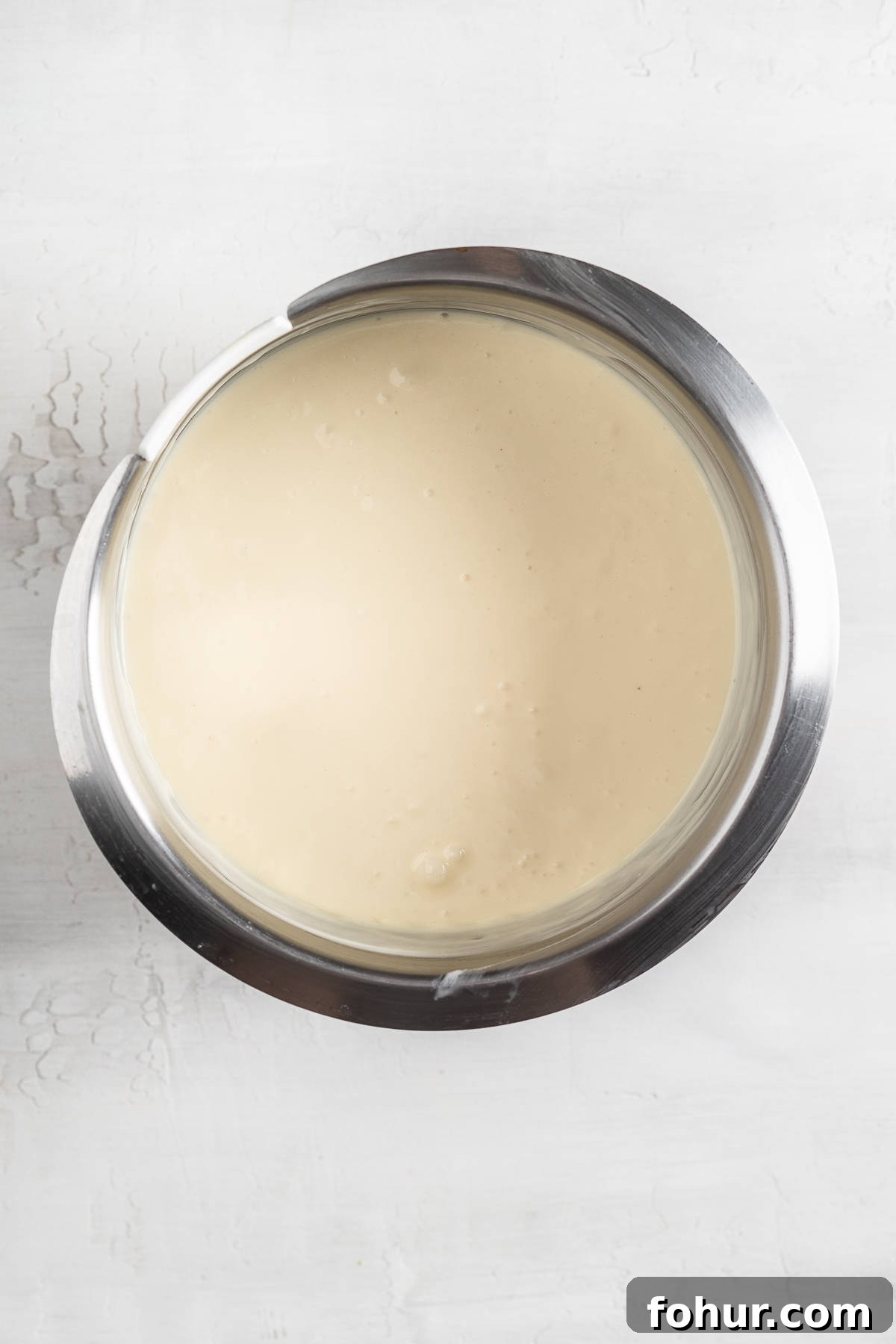
PHOTO 2
Step 5. Pour the batter into the prepared pan and level the top with the back of a spoon or an offset spatula.
Step 6. Bake for about 40 minutes on the center rack. The top should be very dark brown; the center should still be slightly jiggly, like flan.
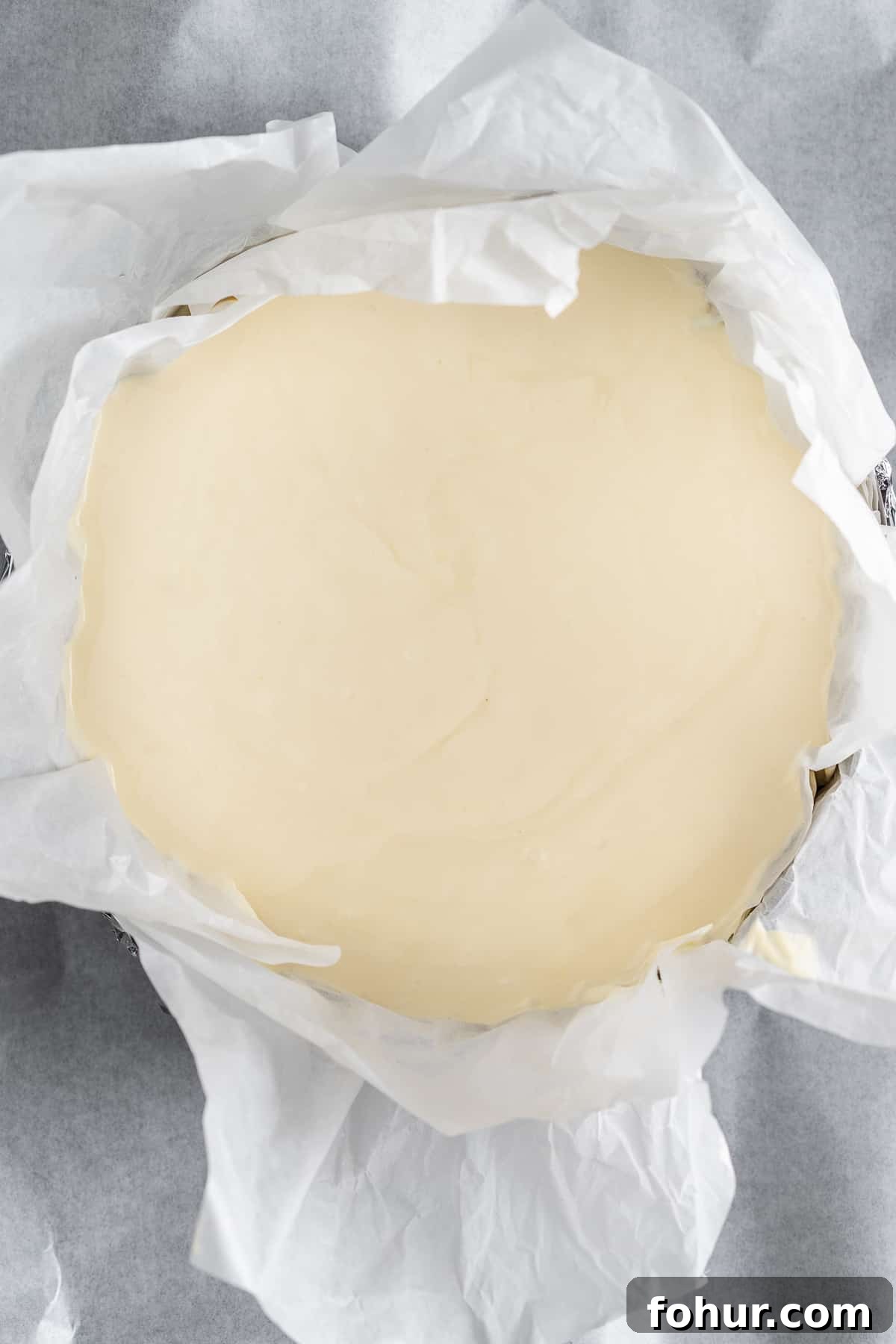
PHOTO 3
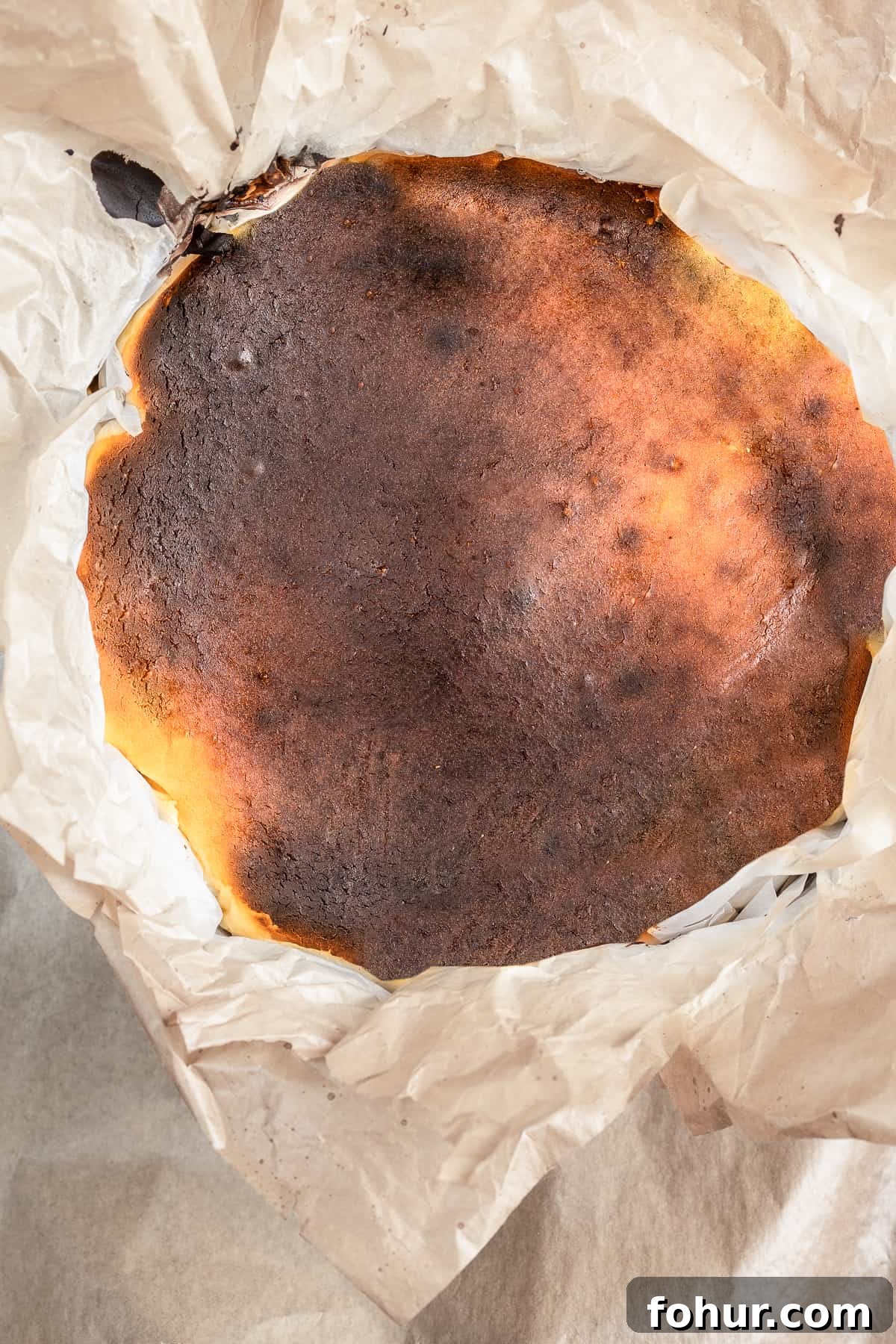
PHOTO 4
Pro tip: Place the pan in the oven quickly to avoid losing heat, and monitor the final 5–10 minutes so the top doesn’t over-char.
If your oven is convection, bake on the middle rack. In a conventional oven, position the cake one rack above the middle but ensure parchment does not touch the heating element. If the top hasn’t darkened enough after the baking time, briefly switch to broil (1–2 minutes), watching carefully — broiling will darken the surface very fast.
Step 7. Remove the cheesecake from the oven and let it cool to room temperature for at least 4 hours. Keep parchment in place while it cools to help the cake retain its shape. Serve the same day or refrigerate overnight. To serve, unmold and gently peel the parchment away from the sides.
Expert Tips
- Bring all ingredients to room temperature before mixing for a smooth, lump-free batter.
- Line the pan with two overlapping sheets of parchment that rise at least 2 inches (5 cm) above the rim to contain the batter and create the classic wrinkled edge.
- Avoid overmixing: stop as soon as ingredients are combined to prevent incorporating too much air.
- Do not overbake: the filling should be slightly wobbly when it comes out; it firms as it cools. Use brief broiling only if necessary and watch it closely.
- Every oven is different — judge doneness by color and wobble rather than time alone.
- For neat slices, dip the knife in hot water and dry it between cuts, then slice confidently in one motion.
- Make-ahead: the cake keeps well refrigerated and often improves in flavor after a night in the fridge; bring to room temperature for at least 30 minutes before serving.
Recipe variations
Texture: You can vary the texture by adjusting baking time. Less baking yields a creamier, slightly gooey center; longer baking gives a firmer, more conventional cheesecake texture.
- For a soft, creamy center, bake as directed and serve at room temperature.
- For an almost custardy, more “raw” center, bake slightly less, chill thoroughly, and bring to the counter before serving.
- For a firmer cheesecake, bake fully and chill for 12+ hours before slicing.
Flavors: The basic batter accepts small additions well. Try a teaspoon of vanilla extract, a little lemon zest, or a splash of dark rum or whiskey. You can also fold in chocolate, matcha, or nut pastes to create flavored variations.
How to serve it
Burnt Basque cheesecake is excellent at room temperature and for several days after baking. Present it with the browned parchment for a rustic look. It pairs well with fruit compote, a drizzle of chocolate sauce, or a dessert wine if desired.
Storing & freezing
Store: Keep the cooled cheesecake in an airtight container in the refrigerator for up to 3 days. Remove from the fridge at least 30 minutes before serving to regain a creamy texture.
Freeze whole: Once completely cooled, remove parchment and freeze the cake on a plate for 1–2 hours, then wrap tightly in plastic wrap and foil. Freeze up to 3 months.
Freeze slices: Wrap individual slices in cling film and foil and freeze for up to 3 months. Thaw in the refrigerator overnight.
Troubleshooting Tips
My cheesecake is runny
Reason: Underbaking or insufficient cooling.
Fix: Bake a few more minutes next time and allow the cake to cool and set for several hours or overnight.
My cheesecake is cracked on top
Reason: Overmixing (too much air), sudden temperature changes, or opening the oven during baking.
Prevention: Mix only until combined, avoid tapping or shocking the pan, and don’t open the oven door during the first 30–40 minutes. Mild cracks often close as the cake cools.
Recipe FAQ
Why is it called San Sebastian cheesecake?
The cake takes its name from San Sebastian, a city in Spain’s Basque Country, where the now-famous version was developed at a local bar.
Is it the same as Burnt Basque cheesecake?
Yes — San Sebastian cheesecake and Burnt Basque cheesecake refer to the same crustless, high-heat baked dessert with a deeply browned top and creamy interior.
Does it have a crust?
No. This cheesecake is baked without a cookie or pastry base.
Can I use a different pan size?
Yes, but baking time will change. Use a pan with tall sides, line it well with parchment, and judge doneness by color and wobble rather than clock time.
Is it gluten-free?
Not in its standard form because it contains a small amount of flour. To make it gluten-free, substitute rice flour or cornstarch for the all-purpose flour.
Recipe card
San Sebastian Cheesecake (Burnt Basque Cheesecake)
San Sebastian cheesecake is a crustless cake with a creamy interior and a caramelized, almost burnt top that delivers complex, caramel-like notes.
- Author: Irina Totterman
- Prep Time: 15 minutes
- Cook Time: 40 minutes
- Total Time: 55 minutes
- Yield: 12 slices
- Category: Cakes
- Method: Baking
- Cuisine: Spanish
Ingredients
- 4 ½ blocks (1 kg) full-fat cream cheese, room temperature
- 1 ¼ cup (250 g) granulated sugar
- 5 large eggs, room temperature
- 2 cups + 2 teaspoons (480 ml) heavy cream, room temperature
- 4 tablespoons (30 g) all-purpose flour
Instructions
- Preheat the oven to 430°F (220°C) for at least 30 minutes, preferably longer.
- Butter a 9-inch (23 cm) pan and line it with two overlapping sheets of parchment that rise about 2 inches above the rim. Press the paper into the base and sides; pleats are expected.
- Beat cream cheese and sugar on medium-low until smooth, about 2–3 minutes, scraping the bowl as needed.
- Add eggs one at a time, mixing after each. Add heavy cream and mix briefly on low. Sift in the flour and mix until smooth.
- Pour batter into the prepared pan and smooth the top. Bake for about 40 minutes until the top is deeply browned and the center is still slightly jiggly.
- If needed, finish with 1–2 minutes under the broiler to achieve a darker top, watching closely to avoid burning.
- Cool to room temperature for at least 4 hours (leave parchment in place). Serve the same day or chill overnight; bring to room temperature before serving for the best texture.
Notes
- All ingredients should be at room temperature to ensure a smooth batter.
- Use two sheets of parchment and let them rise above the pan to prevent overflow.
- Mix only until ingredients are combined; overmixing adds too much air and can cause cracks.
- Judge doneness by color and wobble rather than time. The cake firms as it cools.
- For neat slices, warm and dry the knife between cuts.
Nutrition
- Serving Size: 1 slice
- Calories: 548
- Sugar: 21.2 g
- Sodium: 291 mg
- Fat: 46.2 g
- Saturated Fat: 28.3 g
- Carbohydrates: 26.3 g
- Fiber: 0.1 g
- Protein: 10 g
- Cholesterol: 225 mg
Nutrition information is provided as an estimate for guidance only.