Two-Tiered Christmas Cake — Final Assignment Reflection
This week was final assignment week for the third module of my course. The task was to fill and decorate a two-tiered cake. I chose to bake both sponge layers myself, then fill and decorate them in class. The experience was a mix of satisfaction and last-minute problem solving: I ended up adjusting my plans because of time constraints and a short supply of buttercream, but I’m pleased with how the cake turned out.
Planning and preparation
My original plan was to use a variety of decorating techniques to create an elaborate Christmas-themed cake. I had imagined trying several textures and detailed piping work, but I knew going into the day that I needed to be flexible. Baking my own cakes meant I could control the flavor and structure, and filling and covering them myself allowed me to practice techniques I’ve learned in recent lessons.
Before assembling, I leveled and stacked the layers, then prepared the filling. I intended to use pre-made buttercream, but when we ran out I had to make fresh buttercream from scratch. Making buttercream on the spot added time to the process, which affected how much time I had left for decorating. Still, preparing the buttercream myself turned out to be a valuable refresher in achieving the right consistency for filling and crumb coating.
Assembling and covering
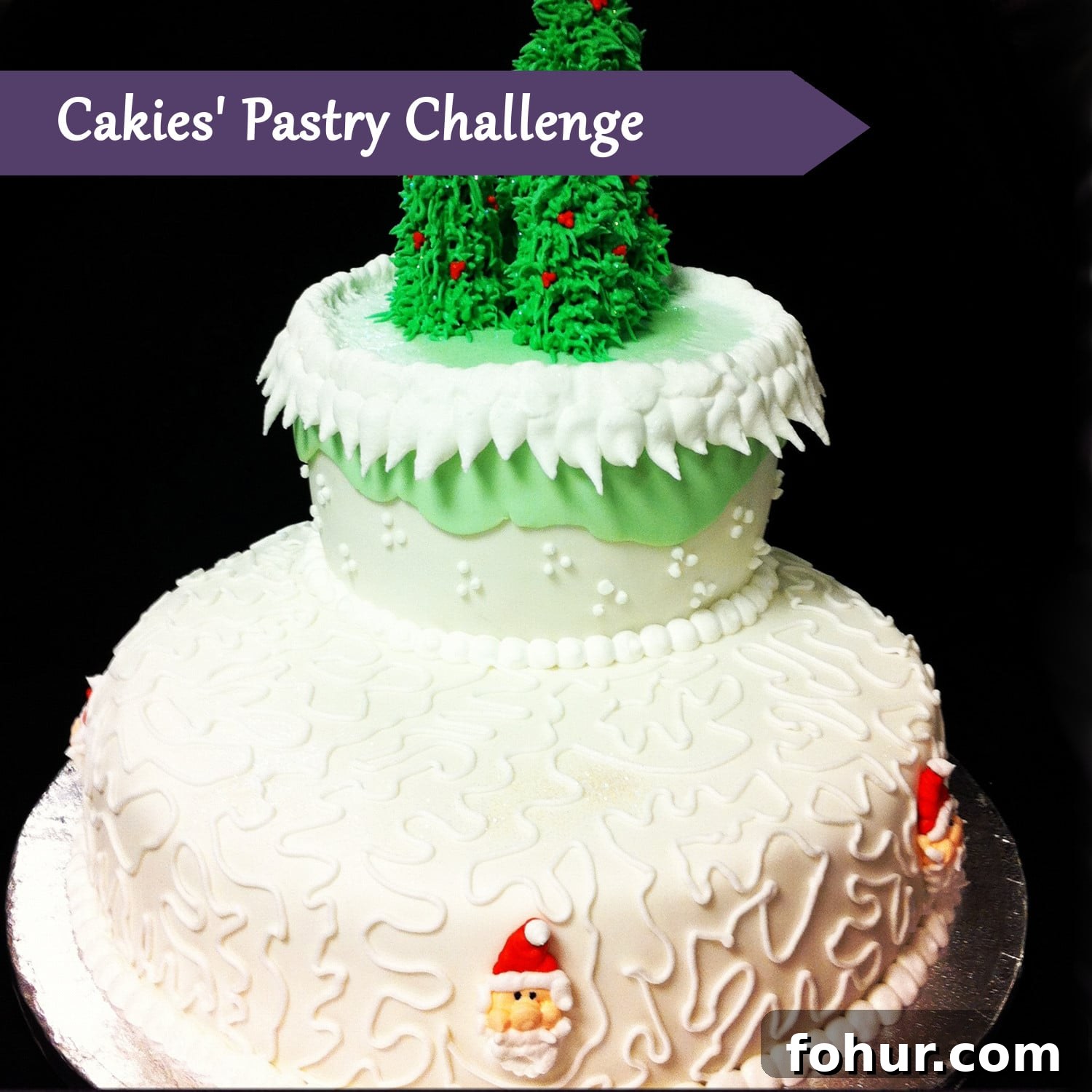
Once the buttercream was ready, I filled both tiers and applied a crumb coat to secure loose crumbs. After chilling the cakes briefly, I smoothed a final layer of icing and covered each tier with white fondant. For the top tier I added a small green fondant topper to introduce a contrasting color and to emphasize the cake’s festive theme. Covering the cakes with fondant went smoothly, and the clean white finish provided a good canvas for the decorations I planned.
Decorating and finishing touches
While I was covering the cakes, a group member prepared royal icing for piping and small sugar decorations. I kept my overall design simple and elegant: a few small Santa figures, several stylized Christmas trees, and decorative piping to tie the elements together. Because I had less time to complete delicate work, I focused on neat, purposeful details rather than attempting many new techniques that require more practice and time.
The piping work was intentionally minimal — delicate borders and small accents that complement the fondant decorations without overwhelming the cake’s clean lines. The Santas and trees were placed strategically to create balance across both tiers, and the green topper on the upper tier provided a focal point that drew the eye upward.
Reflections on the outcome
I’m really happy with the final result. Although I would have enjoyed experimenting with more advanced techniques, keeping the design simple allowed me to execute clean, controlled work within the available time. Finishing a two-tiered cake from scratch — baking the sponges, making buttercream, covering with fondant, and adding royal icing decorations — was a satisfying way to consolidate the skills I’ve developed during this module.
The experience also reminded me of the importance of planning for contingencies: running out of pre-made buttercream meant improvising, but it also reinforced my confidence in making reliable buttercream under time pressure. In future projects I’ll build in extra time for unexpected delays so I can explore more complex decoration methods without feeling rushed.
Looking ahead
I’m eager to see what the next module will bring, but there will be a short break before new lessons resume. For the next two weeks there will be no new classes, and the module work will continue next year. During this break I plan to practice the techniques I used on this cake and to try a few that I didn’t have time for, so I can apply them confidently when the course restarts.
Overall, this final assignment was a rewarding capstone for the module — a practical test of timing, technique, and aesthetic judgment. It left me motivated to keep improving and ready to tackle new challenges in cake decorating.